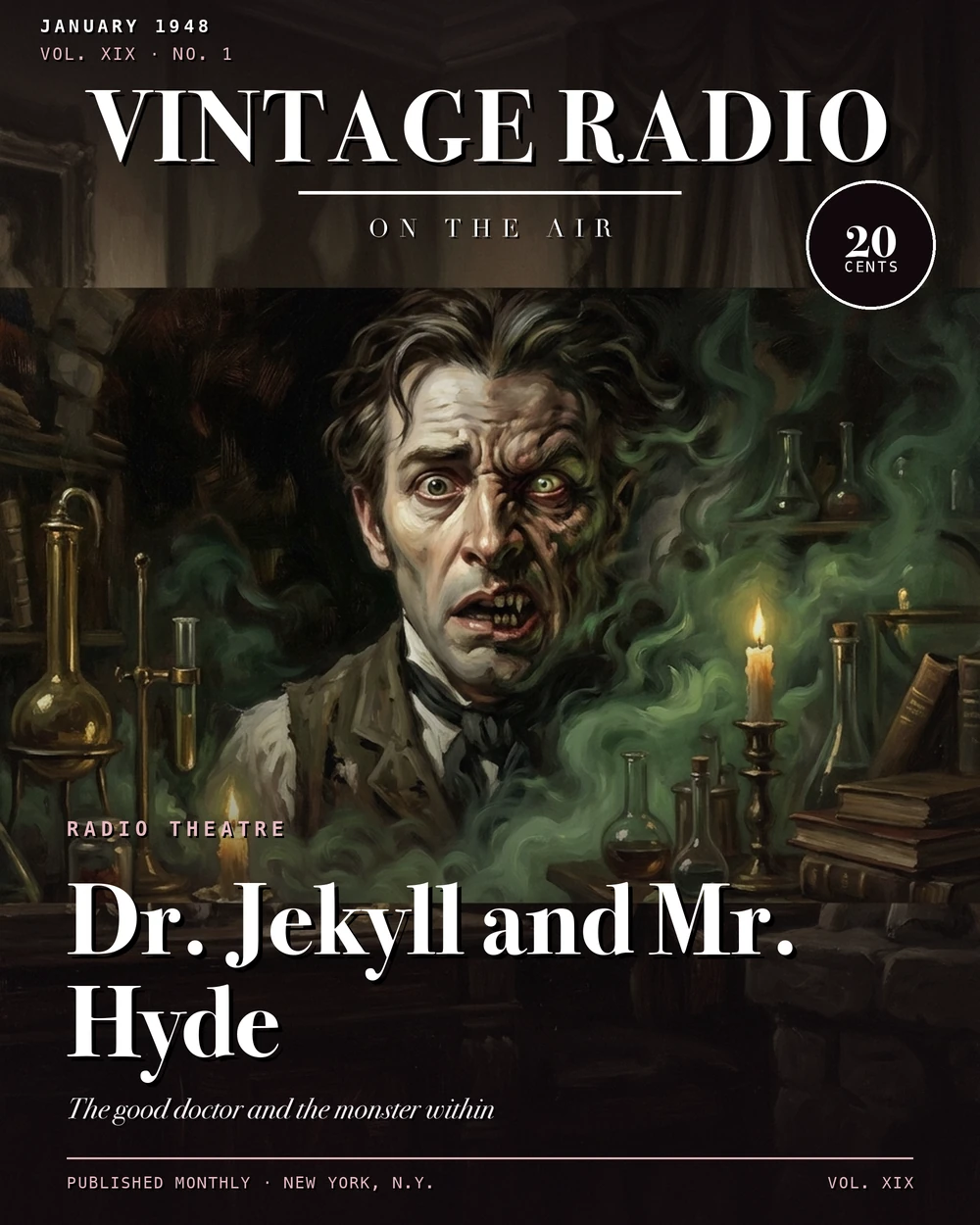
Dr. Jekyll and Mr. Hyde
The Man of a Thousand Voices
The most striking thing about this radio serial isn't the story — it's the man who carried nearly all of it by himself. George Edwards, born Harold Parks in Kent Town, South Australia in 1886, was a comedian, vaudevillian, acrobatic dancer, and stage performer who had reinvented himself as a voice actor for radio. Known by the billing "The Man of a Thousand Voices," he took on the role of Dr. Jekyll and Mr. Hyde and, remarkably, voiced almost every male character in the production as well. One actor, dozens of voices, 52 episodes — it was a feat that could only work on radio, and Edwards had spent decades building exactly the skills it required.
Edwards came to his name as deliberately as he came to his craft. He changed it from Harold Parks to George Edwards, reportedly borrowing from the English theatrical impresario of the same name. Before radio, he had worked stages and variety circuits in the manner of a performer who needed to hold an audience with nothing but himself. When Australian radio serials began to take shape as a format, he moved into them with the same adaptability. Over a twenty-year career he produced more than 300 radio series and serials, including adaptations of Frankenstein, the Corsican Brothers, and Adventures of Marco Polo. Dr. Jekyll and Mr. Hyde was one piece of a remarkably productive run.
The Serial and Its Run
The George Edwards production of Dr. Jekyll and Mr. Hyde ran for 52 episodes, each approximately 15 minutes long — adding up to roughly 11 hours of total programming. The broadcast dates most consistently cited across multiple sources are September 9, 1943 through February 16, 1944, making it an Australian wartime radio production. A few sources point to a possible 1932 origin or production date, but the 1943–1944 window is the most reliably documented broadcast run.
The serial did not simply condense Stevenson's novella into weekly installments. It expanded the story substantially, opening with Dr. Henry Jekyll as a 12-year-old boy and tracing his life through to his death. Romance and new characters were introduced that have no counterpart in the original text — changes that weren't new to this adaptation. Stage productions of Jekyll and Hyde had been adding these elements since Richard Mansfield's 1887 theatrical version, so Edwards was working within a well-worn tradition of dramatized expansions. The radio format, with 52 episodes to fill, simply had more room to develop them.
At 15 minutes an episode, the pacing had to be tight and the storytelling direct. Sound effects, dramatic narration, and voice acting carried the psychological tension that Stevenson had built through prose. The transformation scenes — Jekyll becoming Hyde — were the obvious centerpiece, and radio had its own ways of making them land: changes in vocal register, shifts in the ambient sound design, the narration shaping what the listener's imagination filled in.
What Stevenson Wrote
Robert Louis Stevenson published Strange Case of Dr Jekyll and Mr Hyde in January 1886, after writing it in Bournemouth the previous autumn. Reportedly the initial draft was inspired by a nightmare, and Stevenson rewrote it substantially after his wife objected to the first version. The book sold close to 40,000 copies within six months and was estimated to have sold more than 250,000 copies in the United States alone by 1901. Those are remarkable numbers for the period, and they signal how quickly the story caught hold in the public imagination.
The novella's core situation — a respected doctor whose scientific experiment releases a hidden, violent self — gave the story legs across every format that touched it. Theatre had it almost immediately after publication. Film found it early in the silent era and kept returning. Radio adapted it repeatedly through the golden age. The phrase "Jekyll and Hyde" entered everyday English as a description of someone with wildly contradictory moral character, which is probably the truest measure of how thoroughly the story embedded itself in the culture.
Other Radio Adaptations
The Edwards serial was the most sustained radio treatment of the material, but it wasn't the only one. The story appeared across several well-known anthology programs during the golden age of radio. The Weird Circle adapted it in 1945. In 1948, NBC Favorite Story produced a version selected by Alfred Hitchcock and starring William Conrad. A 1949 CBS Bookshelf of the World production followed. In 1954, NBC's Theatre Royal hosted and starred Laurence Olivier in an adaptation. CBS Radio Mystery Theater returned to the story in 1974 with Kevin McCarthy in the lead.
The Suspense program also featured a notable adaptation, described as capturing the tension and horror of Jekyll's transformation in a way that stayed with its audience. Each of these productions approached the material differently — Suspense in its signature thriller style, the NBC and CBS anthology formats bringing a prestige-broadcast sensibility, Olivier bringing the weight of his theatrical reputation to the 1954 version. That so many distinct programs found the story worth adapting speaks to how naturally it fit the radio Mystery format: a single man, a secret, a body that becomes something else entirely.
Why Radio Suited This Story
The Jekyll and Hyde premise works especially well on radio for a reason that takes a moment to see clearly. In film, the transformation is a visual problem — makeup, lighting, the actor's physicality. In prose, Stevenson handled it largely through implication and reported horror. On radio, the transformation is entirely sonic and imaginative. The listener never sees Hyde; they only hear him. That gap between what is described and what the mind constructs can be more unsettling than anything a camera shows outright.
For an actor like George Edwards, voicing both Jekyll and Hyde in the same serial — and every other male character around them — the challenge was making those distinctions register clearly to an audience that had only his voice to go on. The fact that he sustained this across 52 episodes, holding the dual characterization across a story that stretched from Jekyll's childhood to his death, is a production accomplishment worth noting on its own terms. The serial format also allowed the expanded narrative to breathe: the romance subplots, the new characters, the slow build of Jekyll's deterioration all had room that a single broadcast adaptation or a 90-minute film could never provide.
How It Fits in Radio History
Edwards died on August 28, 1953, having built one of the most unusual careers in Australian broadcast history. The Dr. Jekyll and Mr. Hyde serial stands as a representative piece of that career — a sustained, ambitious adaptation of major literary source material, produced and largely performed by a single man with a background in variety performance and an instinct for the medium. The 52-episode run, with its expanded narrative and its demanding lead performance, occupies a distinct place in the history of radio Mystery programming, separate from the American anthology versions that came before and after it.
The serial's 11-hour total runtime means that across its full run, listeners followed Jekyll from childhood through transformation to death — a scope that no other radio treatment of the material attempted. Whether the broadcast dates trace back to a 1932 origin or begin cleanly in September 1943, the production as it survives gives a clear picture of what Edwards could do with a story and a microphone.